Revived Thoughts Sermon Exclusive
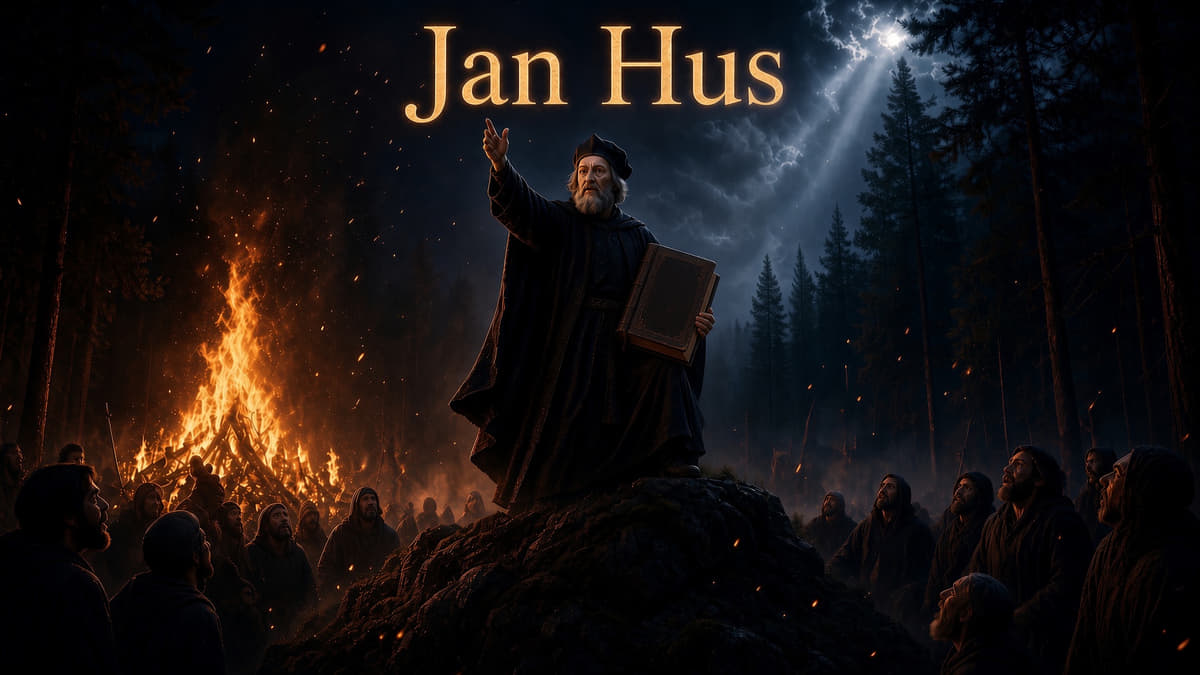
Jan Hus is one of the foremost proto-reformers who helped inspire the Reformation one hundred years later. His followers, the Hussites, resisted the Catholic church into the Protestant era. And his sermons inspired generations. But they were never in English, but most recently given a modernized Czech translation around 60 years ago.
Until now! This sermon, which we are calling The Wheat And The Tares, was originally titled The Papal Bull Against Wycliffe's Works.
In this powerful sermon shortly after Catholic retributions against his teaching which led to the deaths of some of his followers, Hus answers the age old question why God allows weeds to grow among the wheat. That is, why He allows false teachers to exist at all. Be among the first people in history to read it in English! Or listen to it on our podcast, Revived Thoughts.
“At that time Jesus spoke this parable: The kingdom of heaven is like a man who sowed good seed in his field. But while people were sleeping, his enemy came and sowed weeds among the wheat, and went away. When the plants came up and formed grain, then the weeds also appeared. The servants of the owner came and said to him: ‘Master, didn’t you sow good seed in your field? So where did these weeds come from?’ He said to them: ‘An enemy has done this.’ The servants said to him: ‘Do you want us to go and pull them up?’ But he said: ‘No, because while you are pulling the weeds, you might root up the wheat with them. Let both grow together until the harvest; and at harvest time I will say to the reapers: First gather the weeds and tie them in bundles to be burned, but gather the wheat into my barn.’” Matthew 13:24-30
When our merciful Savior had finished this teaching, his disciples did not understand it, as Matthew tells us. They came to him and said, “Explain to us the parable of the weeds in the field.” And he answered and said: “The one who sows the good seed is the Son of Man. The field is the world. The good seed are the sons of the kingdom, and the weeds are the sons of the evil one. The enemy who sowed them is the devil. The harvest is the end of the world, and the reapers are the angels. Just as the weeds are gathered and burned in the fire, so it will be at the end of the world. The Son of Man will send out his angels, and they will gather out of his kingdom everything that causes people to stumble, and those who do evil, and they will throw them into the fiery furnace. In that place there will be weeping and grinding of teeth.” Christ himself explained His own words, and no one can improve on His explanation. So even if there were no other commentary, a believing soul, understanding this, would have enough to meditate on and to weigh carefully. That is why Christ said just before this reading, in Matthew 13:9: “Whoever has ears to hear, let him hear.” But because Christ did not here explain what “the kingdom of heaven” means, you must know this: in this parable, the “kingdom of heaven” means Christ Himself. Because He says: “The one who sows the good seed is the Son of Man,” and at the beginning of the reading it says, “The kingdom of heaven is like a man who sowed good seed in his field,” He is speaking about Himself in this parable. So He is the one who has sown good seed in the world, for He created every good thing. He created Adam and Eve without sin. But then the enemy came and sowed in them the weed of disobedience.
Now first of all, unbelief. For Eve did not believe God that she would die if she ate from the forbidden tree. So she spoke doubting God’s word: “Maybe we would die.” Because of that, when Christ says that the devil sowed the sons of evil, understand this: not that the devil created them, but that by his tempting he made them into children of evil. Sowing into them unbelief, errors, and every kind of sin, he made them into weeds. Now, to prepare you for what follows, since this reading and many others often mention “the kingdom of heaven,” and in one reading it means one thing and in another something else, you must understand how Scripture uses this phrase.
First, “the kingdom of heaven,” as the words themselves suggest, means the assembly of the saints who are in heaven with God, over whom God is King. Being with him, they enjoy heavenly riches. That is, the joy they have in knowing Him. This is how people usually understand “the kingdom” when they hear the words, and that is the sense in the prayer in Matthew 6:10 when we say, “Your kingdom come,” that is: “Let the number of the elect who are to be with you in heaven be brought to fullness.” Likewise, when a man who was sitting at table with Christ said in Luke 14:15: “Blessed is the one who will eat bread in the kingdom of God,” he meant: blessed is the one who after death will be satisfied in heaven.
Second, in Scripture “the kingdom of heaven” can mean Christ Himself. As in Luke 17:20–21: “When Jesus was asked by the experts in the law when the kingdom of God would come, he answered them and said: ‘Look, the kingdom of God is among you.’” The commentary says: here “the kingdom of God” is Christ himself. As if He were saying: “You are asking when people will be in the kingdom of heaven? Look, I am among you. I am the one who will give the kingdom to my faithful ones, and yet you do not recognize me.”
Third, “the kingdom of heaven” here means the Church: that is, the Christian assembly. As in that other passage, Matthew 13:41: “The Son of Man will send out His angels, and they will gather out of his kingdom everything that causes people to stumble.” On this word, Gregory the Great says that we must understand that often in Holy Scripture, “the kingdom of heaven” in the present time means the Church. Of this kingdom the Lord says elsewhere: “The Son of Man will send out His angels, and they will gather out of His kingdom everything that causes people to stumble.” For in that final kingdom of blessedness, where supreme peace reigns, no stumbling blocks will be found that would have to be removed.
Fourth, “the kingdom of heaven” can mean the place of the saints in heaven. As in Matthew 20:21, where the mother of the sons of Zebedee asked Christ: “Say that these two sons of mine may sit, one at your right hand and one at your left, in your kingdom.” Here you see “the kingdom of Christ” means the place where He sits with His saints.
Fifth, “the kingdom of heaven” can mean Holy Scripture. As in Matthew 21:43, where Christ says to the priests and experts in the law: “The kingdom of God will be taken away from you” – that is, the Scripture of the law – “and given to a people who will produce its fruit,” that is, to the good Christians who rightly use Scripture. And in Matthew 23:13 Christ says: “Woe to you, teachers and experts in the law, you hypocrites! You shut the kingdom of heaven in people’s faces; you do not enter yourselves, and you stop those who are trying to enter.”
What does it mean that they “shut the kingdom of heaven” in front of people? John Chrysostom says: Scripture is what shows the kingdom of heaven; the gates of that kingdom are people’s understanding. And those teachers, experts in the law, and hypocrites shut those gates in people’s faces. They prevent simple people from understanding Scripture. And they themselves do not enter into Scripture with true understanding. That is why they hate to see lay people knowing Scripture. They keep them from it, just as Christ says here: they do not allow them to enter. That is, they do not want them to read, and so they do not want them to understand. Especially because they do not want people to understand how they themselves ought to live; second, because they do not want their sins to be rebuked; third, so that people will not recognize their errors in preaching and see that they should study more diligently; and fourth, because they fear they might then seem less important and less honored in the eyes of the laity. But Christ has given them a fitting “blessing” for this, saying: “Woe to you!” And when Christ says “woe,” he is pointing to mortal sin that leads to eternal condemnation. For woe to anyone who ends up there.
Even today many doctors, teachers, priests, experts in the law, and hypocrites, though they have the keys to that kingdom, refuse to open it to others, and even hinder them from entering. So Christ greets them in Luke 11:52: “Woe to you experts in the law! You have taken away the key of knowledge” – that is, of Scripture. “You yourselves did not enter, and you hindered those who were entering.” See, these words of Christ explain his earlier saying, that when he said: “You shut the kingdom of heaven,” he now says: “You have taken away the key” – that is, you close Scripture by taking away understanding.
And there are many like this now. They know Scripture, yet refuse to live according to it or to teach others by it; and if someone does want to teach, they hinder him. Remember this if you want to understand Christ’s words wherever you read about “the kingdom of heaven,” or else you will misunderstand.
Now this reading says: “The kingdom of heaven is like a man who sowed good seed in his field.” That is: Christ, the Son of Man, is like a man who sowed good seed, like a farmer who has sown wheat in his field. The farmer sows wheat in his field; the Son of Man, Christ, sows good people in his Church. For the field means the world, as Christ explains, and the world means the human race, the gathering of people. As in John 1:10: “The world did not know him,” that is, the assembly of evil people did not know Christ by true faith.
The seed is the word of God, the faith, which is a good seed because it makes people into sons of God. Christ has sown that seed in the field of the holy Church, so that people who were at first like good soil – for they were created by God without sin – though later corrupted by sin into soil full of thorns and thistles, are now, by the grace of Christ and through faith, that seed, made into children of God. And so Christ says: “The good seed, these are the sons of the kingdom,” that is: they are my sons, those who belong to me and to salvation by faith and love.
“And while people were sleeping” – that is, when the bishops and priests were lazy and failed to keep watch over Christ’s field, as Augustine says; and also when other people slept, that is, when they did not care about their own salvation – “his enemy came.” Christ says this enemy is the devil, who from the creation of humanity, out of envy, has always been mankind’s enemy.
This enemy, the devil, whom Christ calls “a man,” first sowed weeds when, into that pure soil – Adam and Eve – who had been taught the faith by God, he cast the lie. As we read in Genesis 3:4, he said they would not die. And he did this cleverly: he began with the woman, when Adam was not with her – just as evil men do today when the husband is not with the wife. He questioned her so he could see whether she was inclined to consent. Hearing her answer, as she said, “Maybe we would die,” he at once, as the first liar, spoke not truth but a lie against Christ’s truth and said: “You will certainly not die.” And so he sowed the weeds, as the reading says, “and went away.”
Bede says that often the ancient enemy, when he has already knocked a man down by temptation, withdraws for a time. Not that he means to stop his wickedness, but so that he can return later and tempt him more easily. Sometimes, having drawn a person into sin and now counting him as if safely in his power, like a fisherman with a fish in his trap or on his hook, he goes looking for another. At other times he tempts a man and, failing to overcome him at once, goes away in order to strike more easily later when the man fails to keep watch. As this reading says: “While people were sleeping” – that is, not guarding themselves – he comes and sows weeds.
“And when the plants came up and formed grain, then the weeds also appeared.” That is, when a faith already corrupted by the devil springs up and bears its fruit – outward works that in themselves look good: when someone fasts, gives alms, prays, and yet knowingly remains in mortal sin.
“The servants of the owner came” – that is, the saints of old and the faithful believers now – coming with deep concern. They see how many weeds the devil has scattered among the wheat and they say, astonished: “Master, didn’t you sow good seed in your field? So where does it get these weeds?” – that is, such a quantity and power of weeds? And they go on: “Do you want us to go and pull them up?”
Today’s bishops cling to this sentence strongly. But because they do not know how to distinguish between weeds and wheat, they end up doing more harm to the wheat than to the weeds. They attack truth more than falsehood; they call truth a lie, and a lie truth, so that Isaiah’s prophecy in chapter 5:20 is fulfilled in them: “Woe to those who call evil good and good evil!”
Other blind guides say it does no harm, but is good, to destroy many good people along with one evil person. I have heard them say this, and they give examples: that for one spoiled herring they will destroy the whole barrel. That is, someone will throw away many good ones. And if one piece of cloth is ripped, they will burn the whole sack. And they have openly acted on this. They went to Pope John 23rd and obtained a bull by which he commanded clearly that both the bad and the good books of Master John Wyclif must be burned. They are greatly angered that those books speak about their bribery, pride, fornication, and greed. Most of all, they rage because he calls them receivers of alms and says they should not rule like secular lords. And also because he writes that when priests live wickedly and will not give up their evil, secular lords, by lawful order and good intention, so that the priests have nothing to sin with, may take away their property and also withhold tithes from them.
These statements some doctors, together with canons, parish priests, and monks in Prague, condemned with scorn in the language of German at their town hall. But many masters – in fact almost the larger party of them – and the whole body of bachelors and students would not join in that condemnation. Instead the masters met publicly in the college and proved from Scripture that those doctors and their party had condemned the truth. They summoned those doctors to the school to prove their condemnation from Scripture. But the doctors refused, or rather did not dare, because they had no Scripture by which they could defend what they had condemned.
The main instigator of all this was Štěpán Páleč, that doctor who, when he still loved the truth, had been my loyal and dear friend, and the other was Stanislav. And they stirred it up because we would not agree to the papal bull that gave the cross – that is, authority – to all who wished, priests, nuns, and monks, to prepare themselves to destroy King Ladislas of Naples and all who were under his power and stood with him. In that bull the pope condemned him to the fourth generation and many other terrible things, and he promised forgiveness of sins from punishments to those who would aid in this or pay money for it.
But our merciful Savior gave understanding to many masters, priests, and lay people, so that they did not agree to this for many reasons. Some even laid down their very necks for it. They preached against these false teachers who said that the pope is a god on earth and can give forgiveness of sins and punishments to whomever he wishes, and that he ought to fight with the iron sword like a secular king. Of those good men, Martin, Jan, and Stašek were beheaded, and in God’s name they were buried at Bethlehem Chapel. Others later were arrested, tortured, and imprisoned.
I write this as a faithful chronicle, so that if the same things happen to our descendants, they will know that others before them have bravely faced death for the same cause. And this fits our reading very well: the master forbade his servants to pull up the weeds, lest, thinking they were pulling up weeds, they pull up the wheat as well. For the reading says that the owner told them: “Do not pull up the weeds. Because while you pull up the weeds, you might uproot the wheat with them. Let both grow together until the harvest.”
They do not do this. They do not leave both to grow, but they pull up the wheat and let the weeds grow. For the devil has almost everywhere sown sellers of indulgences like weeds, and bishops and other priests fiercely defend those men, and doctors and others keep silent, not daring to open their mouths against the devil’s weeds. So people have fallen asleep: some from laziness, others from fear, and others because they have been defeated by the devil’s cleverness. Therefore the enemy has sown many weeds among the wheat. The devil has also sown weeds especially because bishops and doctors today refuse to let the reading of Holy Scripture decide the truth; they want to judge by themselves alone, just as the bishops, doctors, priests, and experts in the law condemned Christ by false testimony. And so, with their shameful decrees, they judge and condemn faithful priests who preach against their bribery and other evils.
Yet they should know this: since the counsel of the Virgin Mary and of the whole heavenly kingdom is this – “Whatever He tells you, do it” – and Jesus says in Matthew 10:7–9 that they should exhort people not to store up gold and silver for themselves, to give freely, and not to commit fornication; and now He says here they should let both grow until the harvest, so that they do not, out of their foolishness – and some even out of malice – destroy the wheat along with the weeds, that is, the good together with the evil.
For Christ himself, who cannot err, will on the Day of Judgment say to His angels, as the righteous Judge, to bind the weeds into bundles. The wicked will have their hands and feet bound and will be thrown into the outer darkness. But the wheat – that is, all the elect – will be gathered into the barn of heavenly joy. And notice this: just as weeds are in a certain way useful to the wheat, because they bind the stalks together so they can stand more firmly against the wind and not be shaken as they would be if there were no weeds; and at the beginning the weeds look somewhat like the wheat, so that pulling them too early could harm the wheat if you tug and crush the wheat along with them – in the same way, when evil people are scattered sparsely among the good, they are in a certain way useful to the good. They help them toward a great reward and serve as exercise in spiritual warfare.
If no evil person ever opposed a good person, then the good would have no temptation and no great battle. And so they would not have a great reward. But because evil people are given to the good as a test, so that by standing firm against their wickedness, they gain a great reward, it would be a great loss for the good if all evildoers were now removed at once. Therefore the highest Lord and wisest Master says: “Let both grow together until the harvest.”
Yet sometimes it is right for authorities to weed out the weeds, according to the counsel of God’s word – though not according to all the churchmen’s decrees. Sometimes they may do it, but only with great counsel from people wise in Scripture, from God’s grace, and with great care, so that they do not crush the wheat or tear it up by the roots.
To Peter, in Matthew 18:17, the Savior commanded that if a sinner, after three warnings, still will not repent and his sin is openly known and he will not listen to the Church, then Peter should treat him like a pagan and an open sinner – that is, avoid him – but Christ did not command him to kill him. Yet the present “successors of Peter” have tangled themselves in executions. Declaring a faithful Christian to be a heretic, they hand him over to be burned – making themselves just like the priests who handed over Jesus.